



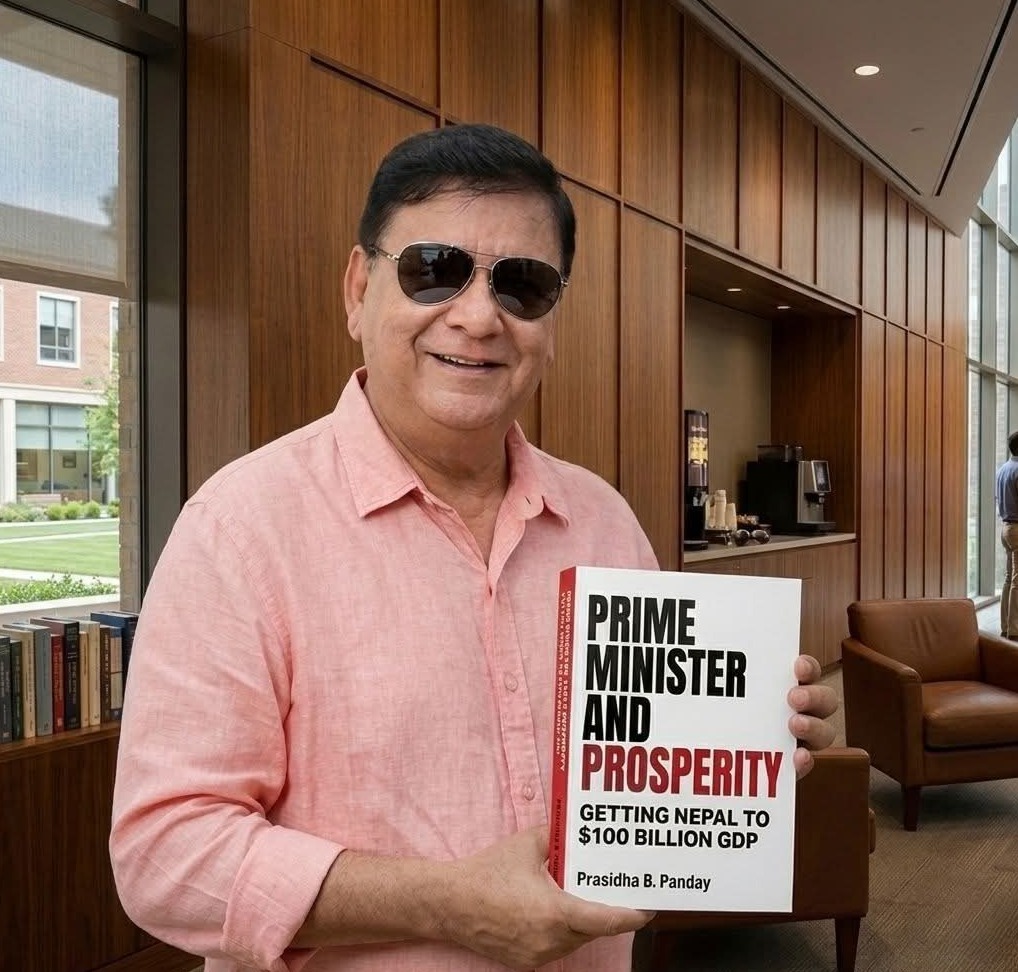

Ask any investor why they hesitate on Nepal and the answer rarely concerns opportunity. It usually concerns predictability. Prasidha B. Panday's new book, Prime Minister and Prosperity: A Leadership Blueprint, takes that hesitation seriously, building an entire argument around the idea that Nepal's USD 100 billion GDP ambition depends less on new ideas than on the systems needed to execute the ideas it already has.
Panday brings a practitioner's eye to the subject, having spent his career across infrastructure, telecommunications and industrial investment before turning to writing.




For readers interested in the business case, the book's treatment of the GDP target itself is worth close attention. Panday resists using the figure as a slogan, tying it instead to capital formation, exports, employment and, crucially, investor confidence, arguing that credibility compounds over time the same way capital does. His attention to employment carries particular weight given how heavily Nepal's economy leans on remittances, a dependence Panday reads less as a strength and more as evidence of how few domestic opportunities currently exist.
Sector by sector, the book builds its case. Hydropower gets examined not as an end in itself but as one part of a chain running through transmission infrastructure and regional buyers, while aviation and tourism are treated as interdependent industries rather than separate line items in a national plan. Pokhara's international airport serves as the book's clearest illustration, standing as proof that infrastructure spending only converts into returns once hospitality capacity, air connectivity and visitor demand develop in tandem.
Agriculture and light manufacturing receive similar treatment. Panday walks through cardamom, tea, coffee, herbs and honey, showing how each product's path to higher-value markets runs through certification, packaging, logistics and financing rather than through production volume alone, a point that will resonate with anyone who has tried to move Nepali goods past the border.
Underlying all of this is a chapter on trust, perhaps the most quietly important section of the book. Panday links investment appetite directly to the predictability of legal, financial and environmental rules, insisting that capital follows confidence long before it follows opportunity, a case worth making loudly to policymakers who still treat investment promotion as a marketing exercise rather than a governance one.
The book's central proposal for achieving all this, the Prime Minister Delivery System, borrows from international delivery units while adapting the model to Nepal's own institutions, concentrating coordination at the centre of government and tracking a limited set of national priorities. Investors reading the book may wish Panday had spent more time detailing how such a system would survive changes in political leadership, since institutional design tends to matter less than institutional durability.
Launched on 28 August 2026 and now stocked in bookstores across Kathmandu, Prime Minister and Prosperity speaks most directly to an audience already thinking in terms of capital, risk and return, offering them a framework for understanding why Nepal's economic potential keeps outrunning its economic performance.
Reviewer: Shreeansh Gurung